Peter Alliss Obituary: White, Whimsy and Golfing Gravitas – A Colossus of Sports and Broadcasting
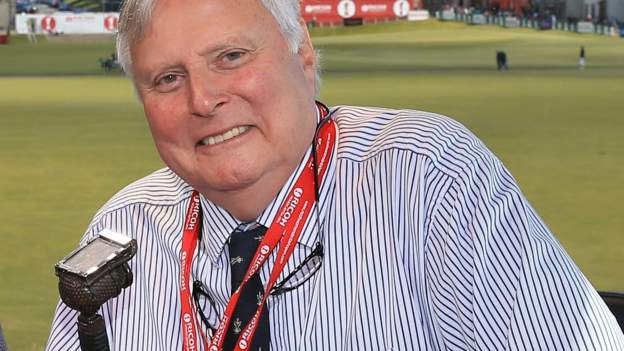
Peter Alliss was talking to a friend on a flight back from Ireland, telling how he had missed an opportunity to win that week's golf tournament. It was a conversation that sparked one of the greatest careers in sports commentary.
Alliss' story about golf problems was clearly beautifully told and overheard by someone working on the television who could see the broadcast capabilities. Ten days later, a letter arrived from BBC producer Ray Lakeland.
It said, so Alliss told me, "I was behind you and you told the story of how you lost and that was really funny. Would you like to come and work with us at The Open? ? "
" I was only 30 years old, still trying to win The Open, "Alliss continued. "But they said just come up after your round and tell us what it was like out there, and that's what I did and I've been there ever since."
And so, at the Open at Royal Birkdale in 1961, Peter Alliss, who died at the age of 89 started a temporary career making him the undisputed & # 39; voice of golf & # 39; made.
His last broadcast didn't come until last month when he described Dustin Johnson's victory at the Masters in Augusta. Due to recent ill health and caution surrounding the Covid-19 pandemic, he commented from a screen in his Surrey home.
In 1961, Alliss combined his very first efforts at the microphone with playing duties, finishing in eighth place behind Arnold Palmer.
Alliss switched from player to commentator and worked for the BBC for six decades
The charismatic American champion started golf popular around the world and paved the way for figures such as Jack Nicklaus, Lee Trevino, Tom Watson and Severiano Ballesteros to become international superstars.
And thanks to the opportunity for an airplane table plan, television sports had discovered the perfect voice to accompany their performance. The images were black and white initially, but Alliss had the words and the delivery to make them technicolor.
He brought with him knowledge and authority that came from a golf dynasty that made him one of Britain's greatest players of the 1950s and 1960s. The son of prominent professional Percy Alliss, was born in Berlin on February 28, 1931.
Weighing in at 14 pounds and 11 grams, he was believed to be the heaviest baby in Europe at the time. used to be. He left school at the age of 14 and devoted himself to the game of golf. In 1946 he played for the English boys' team.
A year later he played in his first Open after a trip with his father to Royal Liverpool.
"I was clearly excited," he told me earlier this year. "The journey by train, from Ferndown to Bournemouth. We got on the bus with golf clubs and suitcases and everyone looked at us when we were angry." What the hell did you have in that bag? " Then the train to London and to Chester and then we had a bus to Hoylake. "
The youngster was somewhat overwhelmed and failed to qualify, but continued with the placing five top 10 & # 39; s in 24 appearances between 1951 and 1974. He has won more than 30 tournaments at home and abroad, including the Spanish, Italian and Portuguese Opens.
Alliss missed the cut in his two Masters appearances in 1966 and 1967, but won the British PGA Championship three times – in 1957, 1962 and 1965. He made his Ryder Cup debut in 1953 in Wentworth.
A fuzzy chip on the last hole cost him a vital half in his singles match against Jim Turnesa when Britain suffered a painful 6½-5½ defeat. & # 39; We should have won & # 39; Alliss later admitted. "And we would have done that if Bernard Hunt and I had won our games."
As a player, Peter Alliss won 21 professional tournaments and achieved five top-10 finishes in the Open Championship
Alliss added: " The Ryder Cup is one of the world's best sporting events. It is an honor to say that I played eight times in golf's greatest team event. "
And there a victory would follow the initial disappointment. In 1957 he was part of the GB team that took its first victory against the Americans in 24 years. “There was a great cheer,” he recalled.
Alliss had an unbeaten record against Palmer in singles matches, taking one and a half points from their two games played when the American was at the height of his power.
But it is because of his broadcasting skills that he will be most remembered.
After Henry Longhurst's death, Alliss took over as the BBC's chief wave commentator. Golf gravitas was complemented by sharp wit and whimsy that gave him a uniquely charming voice. It brought him millions of fans on both sides of the Atlantic.
As golf grew in popularity, he became one of Britain's most famous figures, hosting the highly successful Pro-Celebrity Golf program. on BBC television and his own chat show & # 39; Around with Alliss & # 39; which attracted many of the biggest entertainment stars of the 70s and 80s.
Alliss (left) is said to have given Sean Connery (second right) some golf tips before Goldfinger's shooting, in which James Bond played against the eponymous villain
. His influence on golf went far and wide. He had a course architecture business with Dave Thomas that included among his assignments the Belfry, which has hosted four Ryder Cups. Alliss has also written several books about the game.
He was a traditionalist who enjoyed the peculiarities of golf club life and remained a brilliant and cheerful storyteller to the end. When we met at his house in February of this year, he spent two hours energetically telling me stories about Opens's past and his take on the modern game.
He wondered where the manners had gone and if the stars of today were as skilled as the ones who played in the early 20th century. Most of all, he was still interested and fascinated by the sport. He was determined to continue commenting and was looking forward to attending the 150th Open at St Andrews in 2022.
He had been among the last 69 of them and saw no reason to stop. The game was his life and in it he was an immense and irreplaceable presence.
A colossus in his sport and broadcasting, he will be sorely missed.


