Pete Dye, & # 39; Picasso & # 39; of Golf Course Design, is dead on 94
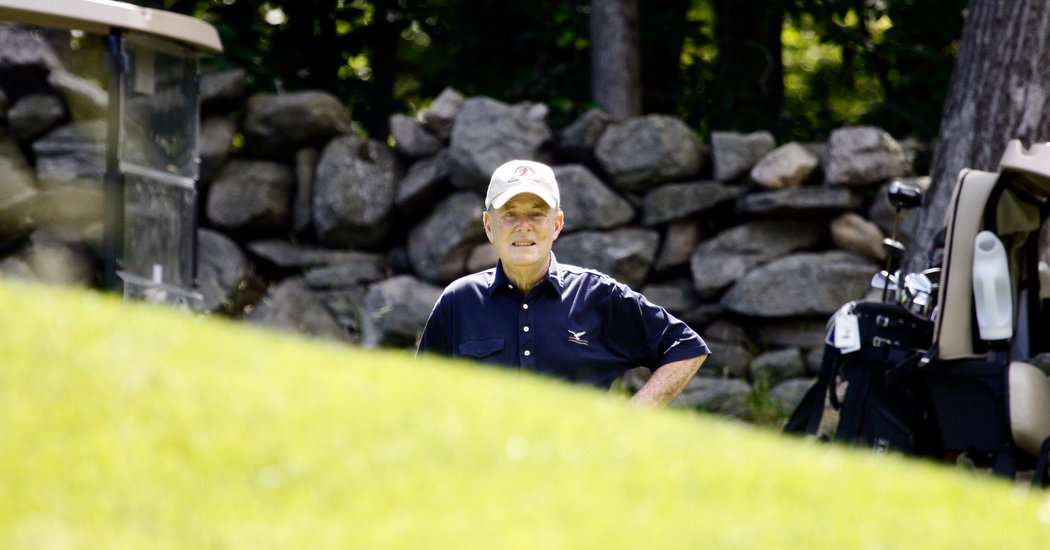
Pete Dye, who designed many of America & # 39; s most famous golf courses and became known as the mad scientist in golf architecture because of his imaginative and extremely challenging layouts, died on Thursday in the Dominican Republic, the site of various Dye family courses. He was 94.
His death was announced by the family business, Dye Designs, on Twitter. He was treated for dementia and previously lived in Gulf Stream, Fla.
Often collaborating with his wife Alice, who died in February 91, and in later years with their two sons, Perry and Paul Burke (known as PB) Dye, Mr. Dye designed more than 100 jobs.
He and his wife were best known for the & # 39; island green & # 39 ;, the 17th hole in TPC Sawgrass in Ponte Vedra Beach, Fla., Probably the most photographed hole in golf history. The green is only about 135 meters from the tee, but it scares even the biggest golfers in the world taking part in the Players Championship, an unofficial fifth major tournament. Surrounded by water and connected to the rest of the course by a slender land bridge, it has tormented even the greatest golfers in the world and is one of the most recognized images in the sport.
When Pete wasn't sure how to fill in sandy terrain that he had dug around the green for transfer to other places on the course, Alice had a solution.
"Originally it was supposed that the water would just play on the right, but we just kept digging, & quoted the Gulf Channel against Mr. Dye." And then one day Alice came out and said, "Why don't you just go on and turn it into an island?" So we did. "
[Read the obituary for Alice Dye.]
Mr. Dye mentioned the 18th hole on his course Whistling Straits in Dyeabolical: A par 4 that measures at least 500 meters plays in often sudden and changing winds from Lake Michigan and requires golfers to ride over sand dunes and bunkers, under approximately 1,000 dangers on the course.
The hole thought in a controversy that will certainly be remembered for a long time when Dustin Johnson, who played in the PGA 2010 Championship, was penalized two strokes for grounding his club before he struck what he thought was trampled but found to be a bad thing bunker or danger, where earthing is not permitted. The fine cost him a chance to enter a play-off for the title (won by Martin Kaymer from Germany).
Rarely use a series of building layout plans, relying instead on his instincts while plotting a course, walking in khaki & work boots or sitting on top of a tractor, Mr. Dye emphasized strategy above brute force.
"I think of Pete like Picasso, someone who made a non-traditional design, whether it is a painting, a sculpture or a golf course," said prominent track designer Arthur Hills by ESPN. "He was so innovative in a profession that is very traditional."
Tiger Woods told Golf Digest in 2008: "The way Pete steps on a property and feels that it is pretty impressive. His courses built for tournaments are difficult, but there is a good reason for everything. "
Paul Dye Jr., known as PD and then Pete was born a youth on December 29, 1925 in Urbana, Ohio, one of the three children of Paul Francis and Elizabeth (Johnson) Dye. His father, a insurance agent, was also an avid golfer and helped build a country club course.
Pete started playing golf like a boy in Florida, where his parents spent the winter months because of his asthma, and he continued to winning the Ohio State High School golf championship.
While serving in the army during World War II, Mr. Dye took care of the golf course at Fort Benning, GA, later when he was stationed at Fort Bragg, NC, officers who heard of his golf background started daily journeys with him to play the Pinehurst Course No. 2.
He met Alice O & Neal when they were members of the varsity golf teams at Rollins College in Winter Park, Fla. Ali CE graduated in 1948, but Pete stopped. They married in 1950, settled in Indianapolis and sold insurance there.
Mr. Dye played in the United States Open in 1957, but his future lay in creating jobs, and in 1959 Pete and Alice designed their first course, the nine-hole El Dorado Golf Club in Indianapolis. Because they were not trained in golf architecture, they struggled for assignments.
"We were the proverbial babes in the forest in a profession that for the most part did not exist at the time," recalled Mr. Dye in his 1995 memoir, "Bury Me in a Pot Bunker, & # 39; with Mark Shaw. "Alice and I would design a course based on the thoughts, images, and memories of the many great courses we had played in the United States."
The turning point in their career came in 1963 , after Mr. Dye participated in the British amateur championship at the Old Course in St Andrews in Scotland, Pete and Alice toured more than 30 courses in Scotland and England, and they photographed them while they were playing.
Like Mr. Dye recalled in his memoir: "My new understanding of the use of small greens, wide fairways, the impression that greens were raised at ground level, contrasting grass mixes, serious undulations in the fairways, pot bunkers, railroad ties, blind holes and the incorporating broom-like vegetation into frame holes would affect all of our future designs. "
In the mid-1960s, the Dyes carved a course from a 400-acre cornfield outside of Indianapolis. While walking across the site during construction, Mr. Dye had picked up a knobby, crooked stick and picked it up As the story went, one of the club's charter members suggested that he would call it Crooked Stick, and it became the first renowned design of the dyes.
Mr. Dye wanted putting pressure on golfers as they approached the last three holes of Crooked Stick, so he created water hazards or bunkers to guard them, while the greens were at ground level, but seemed high because large tracts of soil had been removed from them. in Carmel, Ind., focused on the golf world when unannounced John Daly won the PGA in 1991. Championship there, overwhelming the course with miraculous drive.
Mr. Dye worked with Jack Nicklaus in designing the Harbor Town Golf Links on Hilton Head Island, SC Opening in 1969 as the Heritage Classic site and known for its red and white lighthouse overlooking the 18th hole, the required golfers to go to specific areas to master it at a time when many courses required powerful motivations.
"It was Pete who inspired me to design courses more than 50 years ago, and so I owe him my second career in many ways," Mr. Nicklaus said in a statement.
"I think Pete Dye was the most creative, imaginative and unconventional golf course designer I have ever had," he added. "Pete would try things that no one else would ever think of or would certainly try to do, and he was successful in it. If there was a problem to solve, you solved it in Pete & # 39; s way. In the end Pete & # 39; s way turned out to be usually the right way. "
Dye was probably best remembered for TPC Sawgrass, built on wetlands in Florida, and at the suggestion of Deane Beman, the PGA commissioner at the time, it became the first prominent stadium court, allowing spectators to view the action from elevated areas of the terrain. since the course was opened in 1980, fans have amused by all those balls that land in the water at the 17th hole, so close but so frustrating for the golf elite at the Players Championship.
"What is amazing is that if that greenery was surrounded by sand instead of water, those guys would never miss the green," golf coach Butch Harmon once remarked.
The Dye course schedule also includes PGA West, near Palm Springs, California., And the Ocean Course, on Kiawah Island in South Carolina.
Pete Dye received the PGA Tour Lifetime Achievement Award in 2005 and was initiated in 2008 at the World Golf Hall of Fame. Alice Dye received the PGA of America & # 39; s First Lady of Golf Award in 2004. In addition to her course design work, she defended forward tees that make formidable courses more playable for most women and for male players outside the professional ranks.
In addition to his two sons, Mr. Dye had two grandchildren and two great-grandchildren. Full information about his survivors was not immediately available.
Mr. Dye continued to design courses in his 80s & 80s. Golf Digest named his job at French Lick, Ind., The best new public job in the United States in 2009, and Golf Magazine gave the job its highest honor, best new job of the year.
He created his first course in the state of New York in 2008, the public but championship caliber Pound Ridge Golf Club in Westchester County.
The 15th hole of Pound Ridge, a short par 3, reflected Mr. Dye's sense of adventure. He left behind a large steep rock on a hill overlooking the greenery. When a golfer crossed the green, the rock dropped a few balls onto the putting surface. But it can also cause a shot that bounces back into a water hazard.
"Some golfers will hit that rock, and when their ball bounces off the green, they will say this is a great golf hole," Mr. Dye told The New York Times. "And some golfers, when they hit that rock, their ball will disappear, and they will say that this is the worst hole they have ever seen."


